

Dumbbell movements, or exercises using dumbbells, involve lifting heavy weights in your hands. To succeed in your workout and enjoy its beneficial results for your body, you need to be aware of common mistakes to avoid during a complete strength training session. WODANDGO offers practical advice to work on your physique and gain strength through these dumbbell exercises.
Techniques and tips for successful dumbbell exercises
For a successful dumbbell workout, you should follow a program that includes rest days between sessions. This allows your body to recover and strengthen effectively. Create a balanced routine with movements that target multiple muscle groups.
Start with light weights to focus on technique and reduce the risk of injury. Choose dumbbells that allow you to perform 8 to 15 repetitions without impacting your physical condition. Pay attention to your body's signals to use appropriate weights.
The bench press will allow you to work your pectorals with a large range of motion on a weight bench. Thanks to seated lateral raises, you can engage your shoulders and trapezius muscles. Dumbbells are also versatile; it is possible to increase the difficulty level to enhance the effectiveness of your training sessions.
To perform Dumbbell movements, select equipment suited to each exercise. Visit WODANDGO to discover a wide range of products to improve your performance in weightlifting, cross-training, etc.
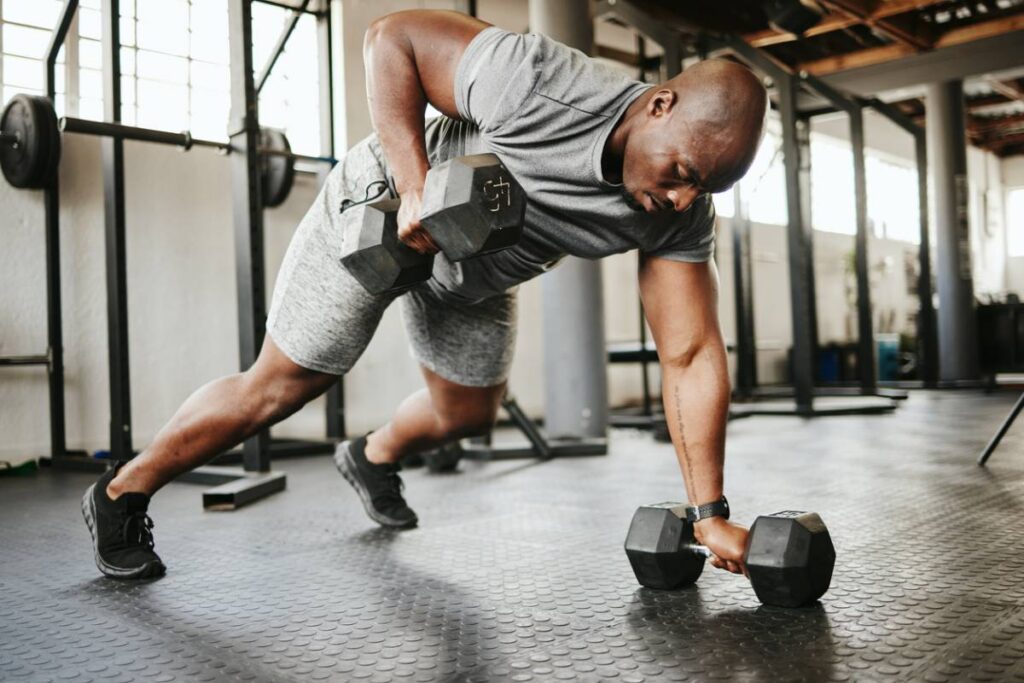
Benefits of performing Dumbbell movements for strength training
Dumbbell exercises offer the possibility of targeting many areas of your body. They dynamically engage stabilizer and antagonist muscles. The diversification of exercises stimulates and develops your body harmoniously. Dumbbell movements are the ideal activity to regain physical stability. By holding weights in each hand, you can identify your weaknesses and create a customized program to ensure your body's balance.
Dumbbell movements strengthen intermuscular coordination and improve flexibility, which is essential to prevent daily injuries. Some postures adopted with heavy weights reproduce natural body movements. You can therefore integrate them into your training routine for strength training. With exercises like squats, lunges, and deadlifts, you can increase your strength and mobility.
These dumbbell exercises allow you to add difficulty when performing a box jump workout, for example. With your dumbbell, you impose additional resistance that impacts your knees, arms, and chest when jumping.
Dumbbell movements to try to improve your performance
To improve your performance with a Dumbbell movement, you can choose the bench press. Lie on a mat with your legs positioned at a 90° angle, feet on the floor, and back flat. Bend your arms and elbows outwards with a dumbbell in each hand. Inhale gently as you start and exhale deeply when your arms are in the air and perpendicular to the floor. Return to the starting position and perform several repetitions until you reach your limits. This way, you can gain strength and increase your muscle mass.
You can also perform lateral raises for the deltoids with dumbbells. Stand on your mat, stay upright, and keep your pelvis in a neutral position. Spread your legs slightly and keep your arms close to your thighs with a dumbbell in each hand. Inhale and simultaneously raise the weights until they are perpendicular to your body. Lock your shoulders and exhale as you lower your arms. To strengthen and tone your glutes, opt for lateral lunges, Dumbbell squats, or leg raises.

Common mistakes to avoid during a dumbbell workout session
To perform a Dumbbell movement, choose dumbbells suited to your physical condition. With weights that are too heavy, you risk compromising your strength training exercises and increasing the risk of injury. To improve your mobility, coordination, or power, apply yourself maximally to master the exercise well. With precise and controlled execution, you benefit from its advantages for your entire body.
You should start your movements after a good warm-up session to prepare your joints for the effort to come. Avoid limiting yourself to a small number of exercises, as this can create an imbalance and slow your progress in muscle toning. Include many Dumbbell movements in your training routine to target several muscle groups. When you feel the first signs of fatigue or pain, stop to preserve your physical integrity.
Remember to focus on your breathing, as you risk getting out of breath after a few minutes of exercise if you don't control it well. Inhale and exhale deeply and regularly during each movement. Also, avoid chaining exercises without giving your body time to rest. Excessive fatigue can lead to injuries that may hinder your progress in strength training.